
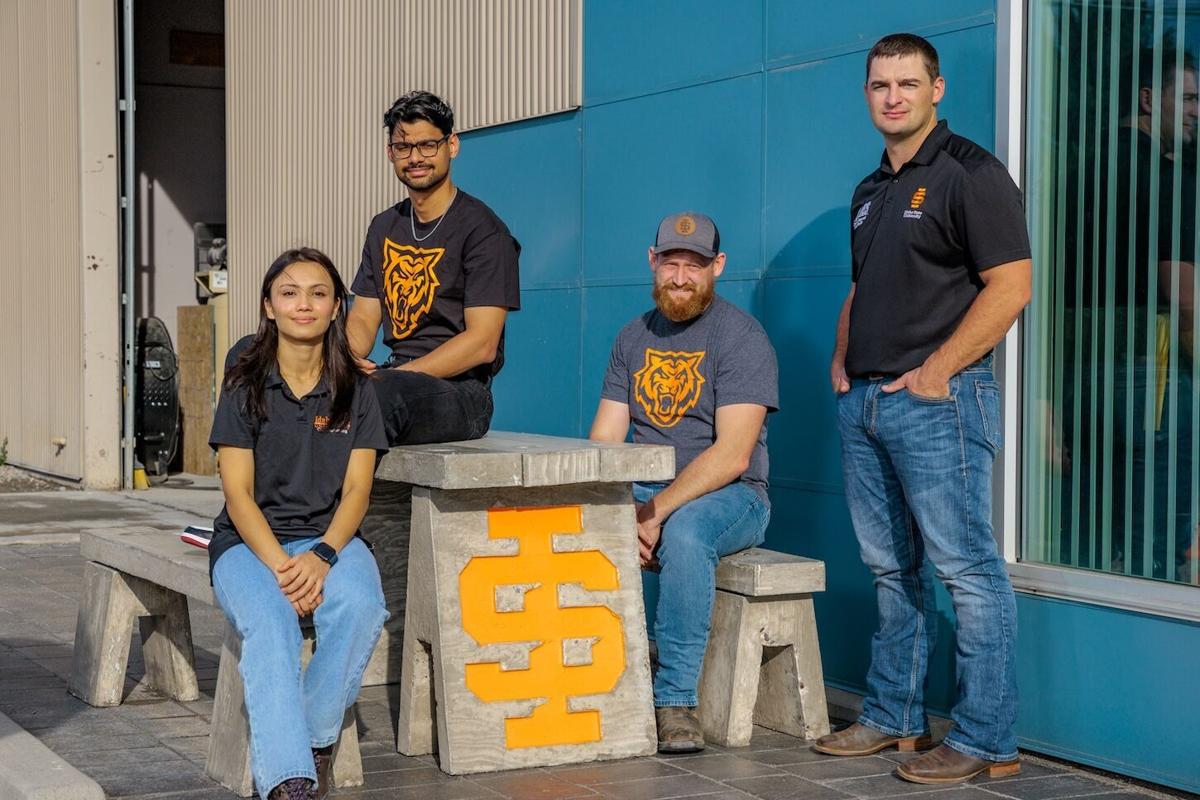
Recently, students wrapped up installation of a picnic table and roughly 350 pavers made of Sweetcrete at the Engineering Research Complex on East Putnam Street in Pocatello. Sweetcrete is a concrete mix that replaces 25 percent of the cement with precipitated calcium carbonate (PCC), a byproduct of processing sugar beets. Prajita Budhathoki, a senior majoring in civil engineering, led a team of students on the concrete table project. Meanwhile, Arpan Adhikari, a recent graduate with a bachelor’s in civil engineering, led a group working on the pavers. The student teams handled everything from 3D-printing the forms to pouring the 45 cubic feet of Sweetcrete to complete both projects.
“My favorite part of working on this project was removing the formwork and seeing the ISU logo successfully take shape in the finished concrete,” said Budhathoki. “It was incredibly rewarding to see the final result after all the planning, preparation, and hands-on work that went into the project. Seeing our research transition from the laboratory into functional, real-world applications was a particularly meaningful and fulfilling part of the experience.”
People are also reading…
“The main goal of the project was to show that PCC, as a sustainable alternative to traditional materials, can be used in real-life applications and not just in laboratory testing,” Adhikari said. “Being able to make the pavers and table and then see them actually being used was probably the best part for me.”
Over the long term, the picnic table and pavers will be monitored to see how well they withstand Pocatello’s freeze-thaw cycles in the winter and how they respond to everyday wear and tear.
“These Sweetcrete pilot projects are a great example of innovations within construction materials,” said Jared Cantrell, director for strategic partnerships and innovation and principal investigator. “The pilot projects allow for active testing of alternative solutions that reduce the reliance on traditional materials and allow opportunities for students to explore material uses beyond the laboratory, producing functional demonstrations right on campus."
Both projects were completed under the supervision and guidance of Cantrell and Joe Shurtleff, laboratory supervisor. Meanwhile, students Truman Reading, Tyler Johnson, Grishma Subedi, Sameer Budhathoki, Abiral Tiwari, Sujan Timsina, Heider Mendoza, Diana Vargas, Uddhav Dev, and Abhinash Gautam helped with the projects.
“Working together during the pour allowed students to gain practical experience with concrete production, placement, and finishing while contributing to the development of a material with potential real-world applications,” said Joe Shurtleff, laboratory supervisor.
Earlier this year, a 9-foot-wide by 71-foot-long pad of Sweetcrete was poured at a Kloepfer Inc. facility in Burley, Idaho, serving as the first real-world stress test of the mix.
The project is supported by Idaho State University’s Office for Research and funded through a grant from the Idaho State Board of Education’s Higher Education Research Council under the Idaho Global Entrepreneurial Mission program. ISU continues research on Sweetcrete’s applications, involving Mustafa Mashal, Kavita Sharma, Emanuele Zappala, and others. The team thanks Brian Roberson of Amalgamated Sugar Company for their continued partnership on these initiatives.