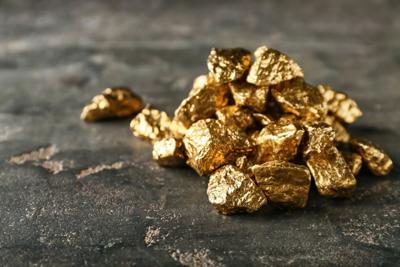


Photo provided by DepositPhotos
In March 2025, an executive order directed federal agencies to expedite domestic mineral production, and it explicitly named gold alongside copper, uranium, and potash as a priority resource. Ten months later, gold hit an all-time high of $5,589.38 per ounce on January 28, 2026.
The policy push and the price surge are now colliding in an unlikely place: creek beds.
Hobbyist prospectors across Nevada, Alaska, and the Sierra foothills are reporting renewed activity, pulling flakes of placer gold out of running water in quantities that carry real financial weight for the first time in decades.
Gold Breaks $5,500/oz for the First Time
On January 28, 2026, gold hit an all-time high of $5,589.38 per ounce. J.P. Morgan analysts are forecasting $5,055/oz in Q4 2026 and $6,000/oz by 2028, which means this isn't a one-day blip.
People are also reading…
For context, a single gram of placer gold (the kind hobbyists actually find in streams) is now worth roughly what an entire week of minimum-wage work paid in 2020. A weekend in the right creek with the right gear can outpace a side hustle driving for a rideshare app.
Demand Jumps 74% as Central Banks Triple Their Buying
The World Gold Council reported that Q1 2026 gold demand hit a record $193 billion in value, up 74% year-over-year. Goldman Sachs has tracked central bank purchases averaging 60 tonnes per month, compared to a pre-2022 average of 17 tonnes.
Meanwhile, the U.S. Geological Survey valued domestic mine production at $12 billion in 2025, with Nevada alone responsible for 64% of all U.S. gold output. Alaska came in second at 22%. California and Georgia round out the historically rich regions where amateur prospectors still find color in the same waterways the 1849ers worked.
So institutions are buying, producers are mining, and a quieter group is showing up on weekends with five-gallon buckets.
Interest in Prospecting Climbs Alongside Spot Prices
Search interest in prospecting equipment has climbed steadily as gold prices broke through each new high. The reason makes sense once you sit with it: most other inflation hedges require a brokerage account and trust in someone else's spreadsheet. Panning a creek requires a pan and a creek.
There's something almost analog about it. You drive out, you get wet, and you might find something real. In a year where most financial conversations revolve around ETF flows and algorithmic trades, a gram of placer gold in your hand feels different.
And it pays better than it used to.
The Cost of Entry for New Prospectors
For anyone curious enough to try, the entry point is lower than most people assume. A basic kit covers a pan, a classifier (basically a sieve), and a sluice box that uses moving water to separate heavy gold from lighter sediment. Most beginners can be ready for under $200 in gold prospecting equipment.
For dry regions like Nevada and Arizona, where there's gold but not always water, prospectors turn to specialized detectors. Minelab metal detectors dominate this category, with models like the GPZ 7000 and GPX 6000 designed specifically to find small gold in mineralized soil that confuses standard detectors. The investment is higher, but so is the potential return when a spot pays off.
The learning curve is steep enough to keep this from being a get-rich scheme and gentle enough that most weekend prospectors break even on gear within a season.
Institutions and Individuals, Same Asset
The next twelve months will test how far the prospecting trend extends. State permitting offices in Nevada and Alaska, the two largest gold-producing states, are positioned to see increased small-claim and recreational mining filings if the executive order accelerates as written. The Bureau of Land Management oversees most of the federal land where amateur prospecting is legal, and any procedural changes there will determine how accessible public claims remain.
There is also a secondary market effect worth tracking. Recyclers and refiners typically see jumps in walk-in business when spot prices break records, and pawn and bullion dealers in gold-producing regions have historically served as the cash-out point for hobbyist finds. If the J.P. Morgan forecast of $5,400/oz holds through 2027, those local economies stand to absorb a measurable share of the increase, separate from the institutional flows that dominate the headlines.