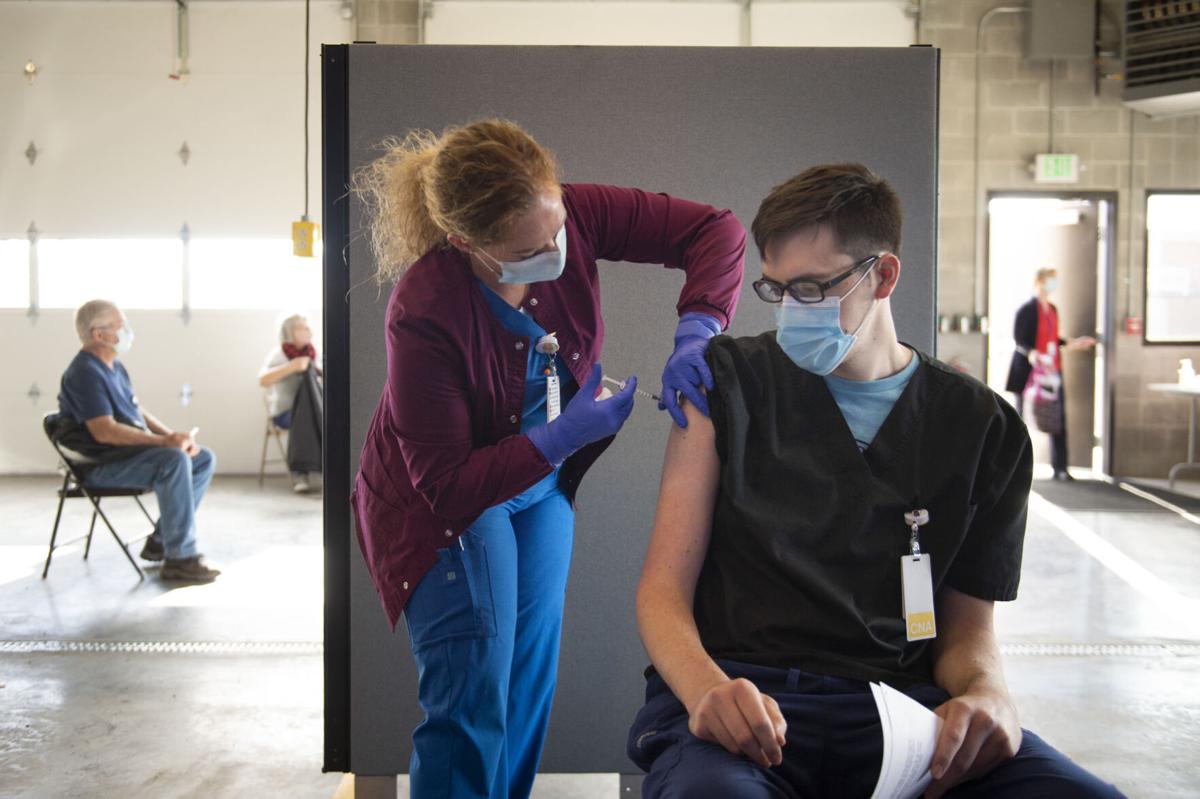
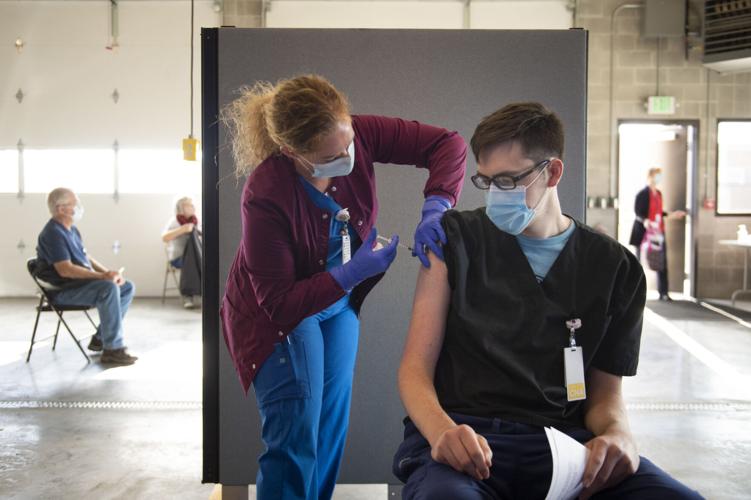
Cathy Villalobos, a licensed practical nurse, gives the COVID-19 vaccine to Jake Parker, a certified nursing assistant, on Tuesday, Dec. 29, 2020, at the Minidoka Memorial Hospital's ambulance bay in Rupert.
Cathy Villalobos, a licensed practical nurse, prepares to give the COVID-19 vaccine to the next in line Tuesday, Dec. 29, 2020, at the Minidoka Memorial Hospital's ambulance bay in Rupert.
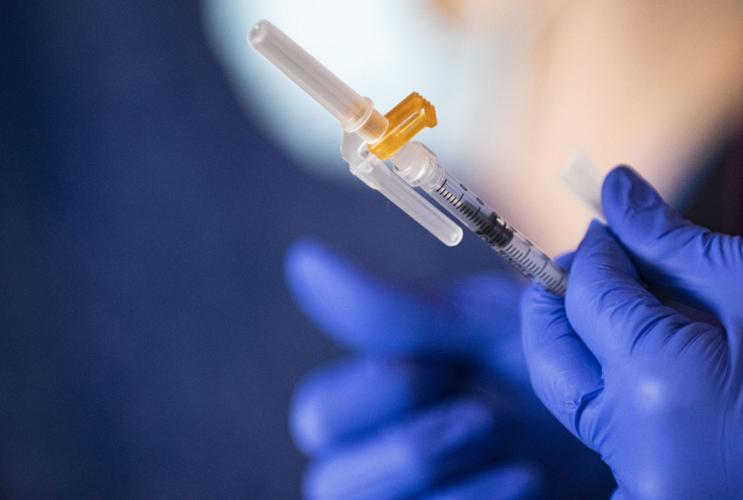
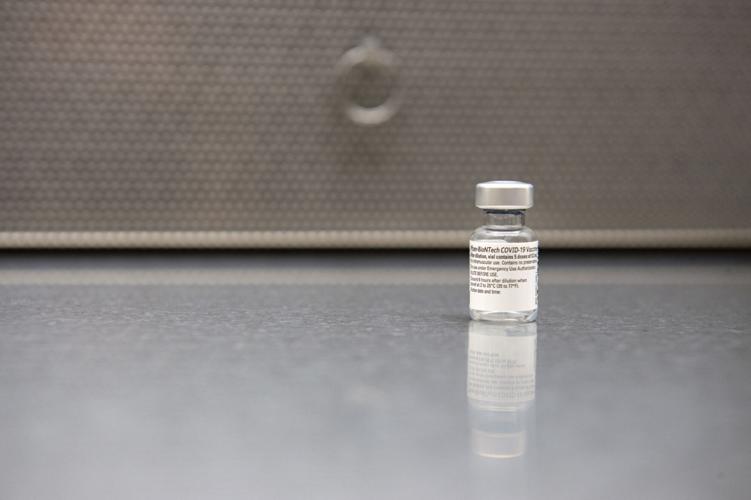
The Pfizer-BioNTech COVID-19 vaccine is being given Tuesday, Dec. 29, 2020, at the Minidoka Memorial Hospital in Rupert. The hospital has been getting six doses out of each vial.
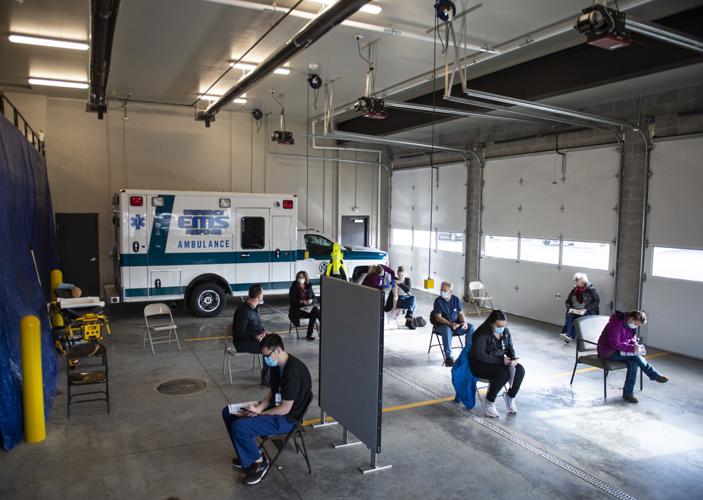
Medical workers get their first round of the COVID-19 vaccine Tuesday, Dec. 29, 2020, at the Minidoka Memorial Hospital's ambulance bay in Rupert.
DREW NASH, TIMES-NEWS
First tier workers get vaccine
Essential workers get their first round of the COVID-19 vaccine Tuesday, Dec. 29, 2020, at the Minidoka Memorial Hospital's ambulance bay in Rupert.
DREW NASH, TIMES-NEWS
First tier workers get vaccine
Cathy Villalobos, a licensed practical nurse, gives the COVID-19 vaccine to Jake Parker, a certified nursing assistant, on Tuesday, Dec. 29, 2020, at the Minidoka Memorial Hospital's ambulance bay in Rupert.
DREW NASH, TIMES-NEWS
First tier workers get vaccine
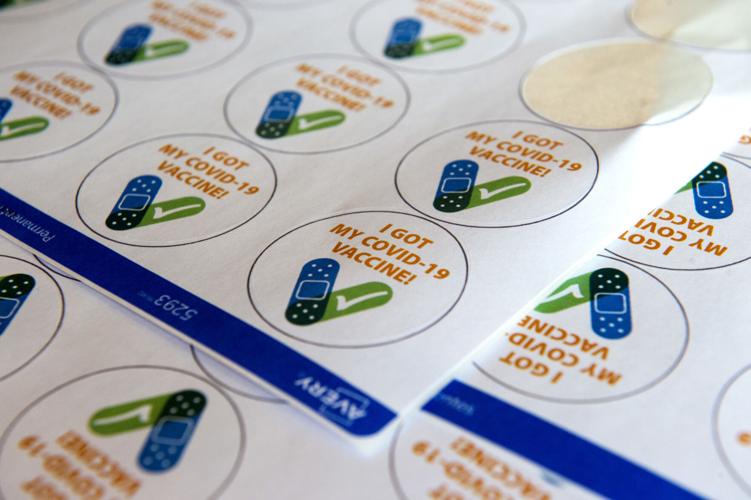
Stickers are given to those who get the COVID-19 vaccine Tuesday, Dec. 29, 2020, at the Minidoka Memorial Hospital's ambulance bay in Rupert.
DREW NASH, TIMES-NEWS
First tier workers get vaccine
The Pfizer-BioNTech COVID-19 vaccine is being given Tuesday, Dec. 29, 2020, at the Minidoka Memorial Hospital in Rupert. The hospital has been getting six doses out of each vial.
DREW NASH, TIMES-NEWS
First tier workers get vaccine
Cathy Villalobos, a licensed practical nurse, prepares to give the COVID-19 vaccine to the next in line Tuesday, Dec. 29, 2020, at the Minidoka Memorial Hospital's ambulance bay in Rupert.
DREW NASH, TIMES-NEWS FILE PHOTO
COVID-19 mRNA vaccine facts
The COVID-19 vaccines currently available in the U.S. were developed by Pfizer-BioNTech, which requires two doses 21 days apart, and Moderna, which requires two doses 28 days apart.
Both are mRNA vaccines.
This type of vaccine works by giving cells instructions to make a harmless piece of what is called the spike protein found on the surface of the COVID-19 virus.
The vaccine is injected into the upper arm muscle and once the instructions (mRNa) are inside the immune cells, they are used to make the protein piece. After the protein piece is made, the cell breaks down the instructions (mRNA) and gets rid of it.
The cell then displays the protein piece on its surface and the person’s immune system recognizes that the protein does not belong there and starts building an immune response and making antibodies. At the end of the process the body has learned how to protect against future infection of COVID-19 without getting sick from it.
The mRNA vaccines can’t give someone COVID-19
They do not use the live virus that causes the illness
They do not affect or interact with a person’s DNA in any way
They never enter the nucleus of a cell where a person’s DNA (genetic material is kept)
Source: Centers for Disease Control and Prevention
The coronavirus pandemic strained hospitals large and small, forcing them to hunt for open beds elsewhere in the state and region. They relied…
Cathy Villalobos, a licensed practical nurse, gives the COVID-19 vaccine to Jake Parker, a certified nursing assistant, on Tuesday, Dec. 29, 2020, at the Minidoka Memorial Hospital's ambulance bay in Rupert.
Cathy Villalobos, a licensed practical nurse, prepares to give the COVID-19 vaccine to the next in line Tuesday, Dec. 29, 2020, at the Minidoka Memorial Hospital's ambulance bay in Rupert.
The Pfizer-BioNTech COVID-19 vaccine is being given Tuesday, Dec. 29, 2020, at the Minidoka Memorial Hospital in Rupert. The hospital has been getting six doses out of each vial.