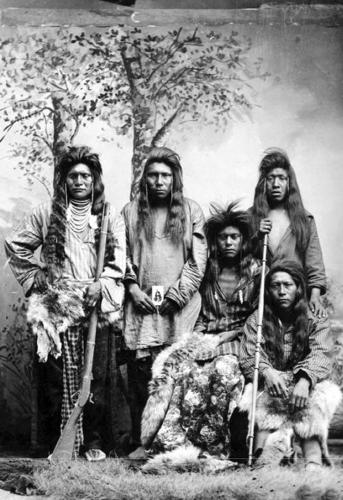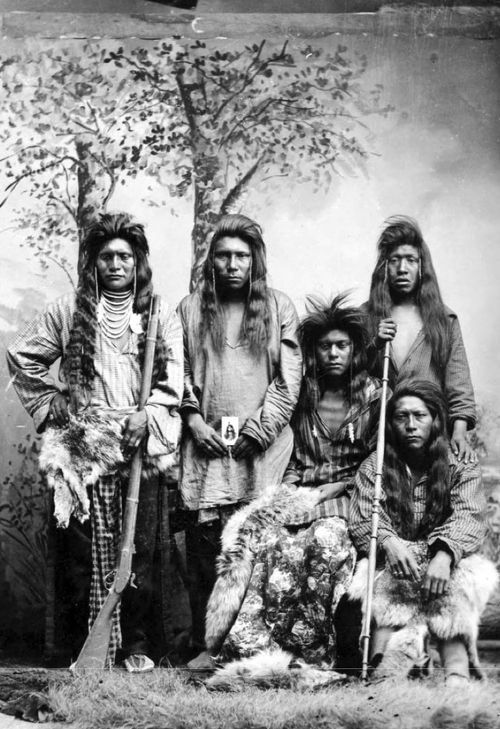
Shoshoni Indians are seen in this 1870 photo courtesy of the Utah Historical Society.
Editor’s note: This column ran Oct. 30, 2013, as a blog on Magicvalley.com.
According to locals, Northern Shoshoni warriors under Chief Pocatello attacked a wagon train in 1861 and killed nearly 300 westbound settlers near Almo. There’s a monument honoring those killed in the massacre next to the Almo schoolhouse on Main Street.
Most historians dismiss the so-called massacre, saying it never happened. Some have called for the removal of the monument, which was erected more than 75 years ago by the “Sons and Daughters of Idaho Pioneers.”
Other historians are more forgiving, saying several small skirmishes happened in the 1850s and 1860s, which, over time, have melded into one in the collective memory of the town.
Almo is a town lost in time. And that’s the way the residents like it.
People are also reading…
It’s a very old town — the Almo store rivals James Bascom’s store (now known as the Stricker Store) at the Rock Creek Station south of Hansen as being the first trading post in the Magic Valley.
Charlie Walgamott, Lucy Stricker’s brother, wrote the first published account in 1925 — almost 65 years after the massacre. In his book “Reminiscences of Early Days,” Walgamott claims that he visited the battleground in 1875 and saw evidence of the battle “marked plainly by trenches thrown up under each wagon as they were arranged in circles.”

Arlo Lloyd points out iron residue on a rock found along the California Trail in southern Cassia County. Pioneer wagon wheels slipped on rocks along the trail, leaving imprints that have rusted over time.
Walgamott also gave the name of a man — W.M.E. Johnston, then living in Twin Falls — who had “confirmed” the massacre. Johnston was 14 and lived in North Ogden, Utah, when the massacre happened, Walgamott said.
Johnston claimed that a man and a woman had escaped the battle and had made their way to Brigham City, Utah, looking for help.
Brigham D. Madsen, a former University of Utah historian, discredits Walgamott’s story in his paper “The ‘Almo Massacre’ Revisited.”
If there had been a massacre, it would have been reported in the Sacramento and San Francisco newspapers, “which kept careful track of Native American massacres along the California Trail,” Madsen said.
“When even the slightest Native American disturbance along the road received immediate notice from these various western newspapers,” he said, “the lack of any reference to an affair at Almo Creek can only mean that there was no ‘Almo Massacre.’” Madsen claimed the Almo Creek Massacre monument was the brainchild of Byrd Trego, publisher of the Blackfoot Daily Bulletin.
Trego thought the erection of the monument in 1938 would help his crusade to make the City of Rocks a national monument, Madsen said. The monument perpetuates a lie, he said; he recommended replacing it with a monument to Chief Pocatello.
Fat chance.
Whether the Almo Creek Massacre happened or not, the legend is thoroughly entrenched in the soul of the little village.

Matthews
Mychel Matthews reports on rural issues and agriculture for the Times-News. The Hidden History feature runs every Thursday in the Times-News and on Magicvalley.com. If you have a question about something that may have historical significance, email Matthews at mmatthews@magicvalley.com.

Mychel Matthews
Executive Editor